
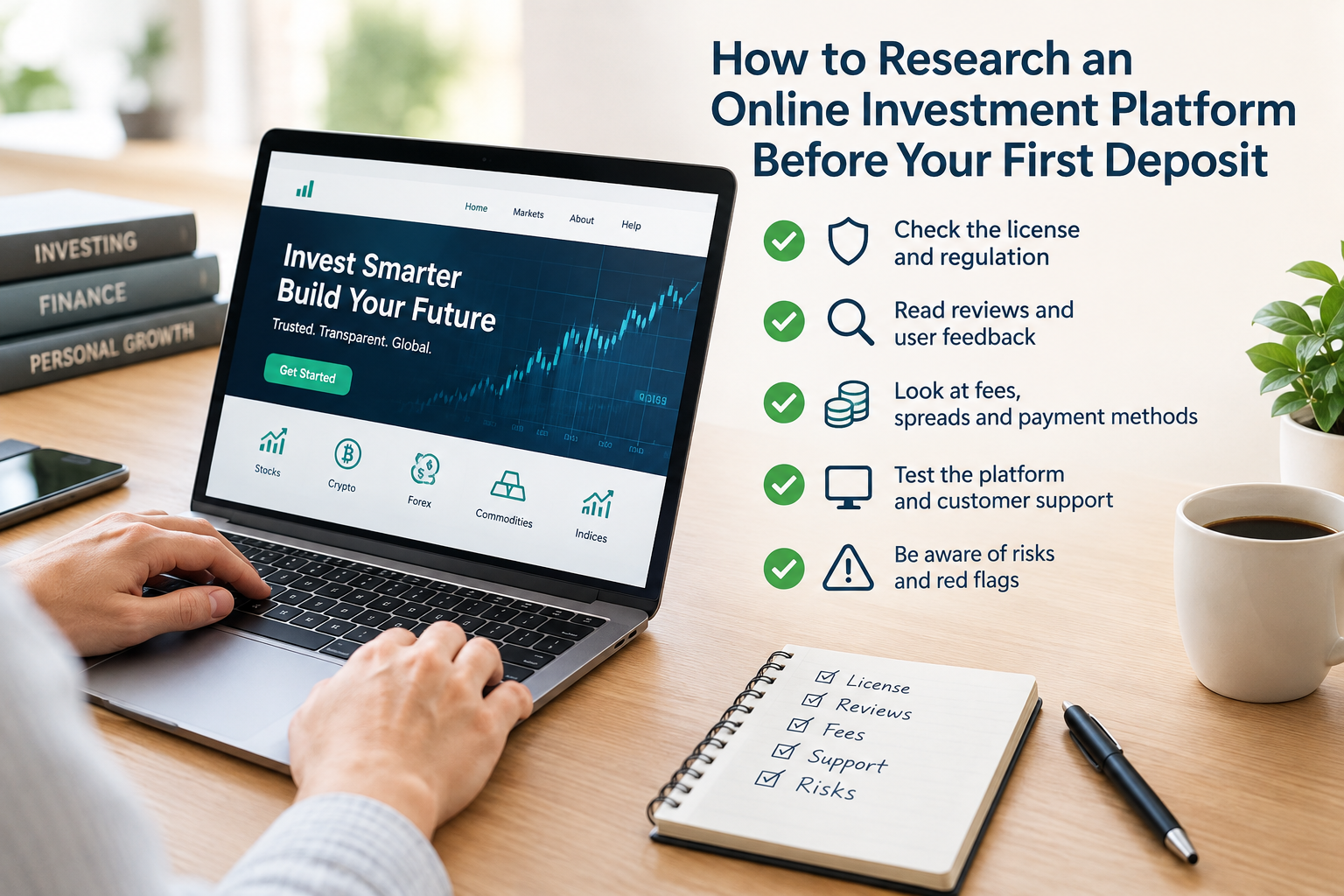
Finding an online investment platform can take only a few minutes. Researching it properly before making your first deposit can take considerably longer.
Whether you are looking at a traditional investment platform, a digital investment service, a crypto-related project, or a higher-risk online investment opportunity, it is important to understand what you are actually dealing with before sending money.
A professional website does not automatically mean that an investment opportunity is suitable or trustworthy. At the same time, being a relatively new platform does not automatically mean that it is fraudulent.
The goal of research is to collect enough information to understand the platform, its potential risks, and the conditions attached to using it.
Why Research an Investment Platform Before Depositing?
Your first deposit is an important point because it changes your relationship with the platform.
Before depositing, you can investigate the company without putting your funds at risk. After depositing, you may have to deal with withdrawal conditions, verification requirements, fees, investment periods, or other restrictions.
A few minutes of research may reveal information that is not immediately visible on the platform’s homepage.
Good research should answer some basic questions:
- Who operates the platform?
- How does the investment opportunity work?
- What are the potential returns?
- What are the risks?
- How can you deposit and withdraw?
- Is the company regulated or registered?
- What do independent sources say?
- What happens if you want to stop using the platform?
These questions can help you build a clearer picture before making a decision.
Start With the Platform’s Official Website
The official website should be your starting point, but it should not be your only source of information.
Go through the main sections instead of looking only at the homepage.
Check whether the website clearly explains:
- The company or operator
- Investment products
- Fees
- Deposit methods
- Withdrawal procedures
- Terms and conditions
- Privacy policy
- Contact information
- Risk information
Take note of anything that is unclear.
For example, if a platform prominently advertises potential returns but provides very little information about how those returns are generated, further research may be appropriate.
Find the Company Behind the Platform
One of the most useful steps is identifying the legal entity operating the website.
Look for the company’s full name in the Terms and Conditions, About page, footer, or other legal documents.
Once you have the name, research it separately.
You can look for:
- Company registration information
- Regulatory information
- Business history
- Management information
- Previous websites or brands
- Independent mentions of the company
Do not assume that a company name displayed on a website proves that the business actually operates the platform.
The information should be consistent across multiple sources.
Check the Domain and Website History
The website’s domain history can provide useful context.
A newly registered domain does not automatically indicate a problem. However, it may mean that there is limited history available for the platform.
Compare the domain’s apparent age with the company’s claims.
For example, if a website claims to have been operating for many years but its current domain was only registered recently, try to understand why.
Possible explanations can exist, such as a company changing domains or launching a new website. The important point is to investigate rather than immediately assuming either the best or worst.
Understand How the Investment Works
Before depositing, make sure you understand what you are actually investing in.
Ask yourself:
What is generating the potential return?
For traditional investments, this may involve stocks, bonds, funds, real estate, or other identifiable assets.
For digital assets, the explanation may involve cryptocurrencies, staking, lending, trading, or other activities.
For some online investment projects, the explanation may be much less clear.
If you cannot explain in simple terms how the platform claims to generate returns, consider researching the model further before depositing.
You should not invest simply because the advertised percentage looks attractive.
Examine the Expected Returns
Returns are one of the first things many investors notice, but they should be examined in context.
Look at the complete investment conditions rather than focusing on one percentage.
Check:
- Is the return fixed or variable?
- Is it guaranteed or only projected?
- How frequently is it calculated?
- Is the principal included in the advertised amount?
- Is there a minimum investment period?
- Can the investment be withdrawn early?
- Are fees deducted from the return?
The higher the advertised return, the more important it becomes to understand the associated risk.
An unusually high return combined with minimal discussion of risk deserves additional research.
Read the Withdrawal Conditions
Withdrawal conditions are particularly important because they determine how you can access your money after depositing.
Before making a deposit, find out:
- What is the minimum withdrawal?
- How long do withdrawals normally take?
- Are there withdrawal fees?
- Is identity verification required?
- Are there investment lock-up periods?
- Can funds be withdrawn before the investment period ends?
- Are there additional conditions?
If the withdrawal policy is difficult to find or written in a way that is difficult to understand, take your time before depositing.
Never assume that because a platform accepts deposits, withdrawals will automatically be simple.
Research Deposit Methods
Look at how the platform accepts funds.
Common methods can include:
- Bank transfers
- Debit or credit cards
- Cryptocurrency
- Payment processors
- Other digital payment methods
The payment method itself does not establish whether an investment platform is legitimate.
However, understanding the payment process is still important.
For example, cryptocurrency transactions are generally difficult to reverse. If you send funds to an incorrect address or to an unsuitable recipient, recovering them may be difficult or impossible.
Always double-check the payment details before sending money.
Search for Independent Reviews
After examining the official website, search for independent information.
Use the platform’s exact name and try different searches, such as:
Platform name + review
Platform name + withdrawal
Platform name + complaints
Platform name + experience
Platform name + scam
Do not judge a platform based on a single search result.
Look for patterns across different sources.
A review that simply repeats the platform’s marketing material may provide little additional information. A useful independent review should ideally discuss both the potential advantages and the risks.
You should also be aware that some online reviews may contain affiliate links. An affiliate relationship does not automatically make a review unreliable, but it is useful to know who may financially benefit from a referral.
Check Regulatory Information
If an investment platform claims to be regulated, verify the claim independently.
Do not rely solely on a regulatory logo displayed on the website.
Find the relevant regulator and check whether:
- The company actually appears in the regulator’s database
- The company name matches
- The registration or license number is valid
- The authorization covers the services being offered
Regulation can be an important factor, but it is not the only factor you should consider.
A platform can also operate in a jurisdiction or business structure that has different regulatory requirements.
Look at the Terms and Conditions
Terms and Conditions can tell you much more about a platform than its marketing pages.
Pay particular attention to sections concerning:
- Deposits
- Withdrawals
- Fees
- Account verification
- Account suspension
- Investment periods
- Refunds
- Changes to services
- User responsibilities
You do not need to memorize every paragraph.
Instead, look for conditions that could materially affect your ability to use or withdraw your funds.
Test Customer Support Before Depositing
A simple way to learn more about a platform is to contact customer support before sending money.
Ask a straightforward question about withdrawals, fees, or investment conditions.
Then evaluate the response.
Good support should be able to explain the platform’s basic procedures clearly.
Be cautious if representatives:
- Avoid answering simple questions
- Contradict information on the website
- Pressure you to deposit immediately
- Promise unusually high returns
- Ask you to send money through unusual channels
- Contact you repeatedly after you say you need more time
There is no good reason to rush an investment decision simply because someone is encouraging you to deposit today.
Don’t Confuse Popularity With Safety
A platform can have a large social media following and still require careful research.
Likewise, a platform with a small online presence is not automatically unsafe.
Social media metrics can be useful for understanding how a project presents itself, but followers, likes, comments, and promotional posts are not substitutes for due diligence.
Focus on information that can actually help you understand the business and its investment model.
Start Small If You Decide to Proceed
Research cannot eliminate investment risk.
If, after completing your research, you decide that a platform is worth considering, think carefully about the amount you are willing to risk.
A smaller initial amount can limit your exposure while you learn how the platform operates.
However, this should not be interpreted as a guarantee that a small deposit is safe.
Never deposit money simply because you believe you can withdraw the initial amount quickly.
The amount invested should be money you can afford to lose without affecting essential expenses.
Keep Your Own Records
Before making your first deposit, save copies of important information.
This can include:
- The investment terms
- Fees
- Withdrawal conditions
- Deposit confirmation
- Transaction ID
- Relevant emails
- Account information
Websites can change their terms, investment plans, or fee structures.
Keeping your own records makes it easier to understand what conditions applied when you made your investment.
A Simple Research Process
You can turn the entire process into a simple checklist.
Step 1: Identify the platform
Write down the exact website address and company name.
Step 2: Find the operator
Determine which company or organization is behind the platform.
Step 3: Check the history
Research the domain, company history, and previous information about the project.
Step 4: Understand the investment
Make sure you understand how the platform says it generates returns.
Step 5: Review the conditions
Check returns, fees, minimum deposits, investment periods, and withdrawal rules.
Step 6: Verify important claims
Independently check regulatory, company, and licensing claims where applicable.
Step 7: Search for independent information
Look for reviews, complaints, discussions, and withdrawal experiences.
Step 8: Contact support
Ask questions before depositing and evaluate the response.
Step 9: Assess the risk
Decide whether the potential return justifies the risk you are taking.
Step 10: Make your decision
If important information remains unclear, there is no need to rush.
What If You Still Cannot Decide?
Sometimes research produces more questions than answers.
That is normal.
If you cannot determine who operates a platform, how the investment works, or how withdrawals are handled, you do not have to deposit immediately.
There are always other opportunities to research.
Taking more time can be a better decision than making a rushed investment because of a limited-time promotion or pressure from a salesperson.
For additional guidance, see our articles on Investment Website Red Flags and HYIP Due Diligence.
Final Thoughts
Researching an online investment platform before your first deposit is not about finding a single website check that proves whether an opportunity is safe.
It is about putting together several pieces of information.
Check the company, website history, investment model, expected returns, fees, withdrawal conditions, regulatory claims, independent reviews, and customer support.
Most importantly, understand what you are putting your money into and how much you could potentially lose.
A few extra hours of research can help you make a more informed decision and avoid problems that might otherwise become apparent only after you have deposited.
For more investment research and information, explore our Investment Programs section and our guides covering online investing, HYIP due diligence, investment website risks, and crypto wallets.