


Choosing a cryptocurrency exchange is not always easy, especially if you are relatively new to digital assets. There are plenty of platforms available, but they do not all offer the same experience. Some focus on advanced trading tools, while others try to make buying and holding cryptocurrency as straightforward as possible.
Coinbase is one of the best-known names in the cryptocurrency industry. The company has been operating since 2012 and has built a platform that combines cryptocurrency purchases, trading, digital asset storage and several additional services.
One reason people consider Coinbase is its relatively simple interface. Another is its position as a publicly traded cryptocurrency company, which gives users access to more corporate information than they might find with some privately operated exchanges.
But is Coinbase actually worth considering in 2026?
In this review, we take a closer look at how the platform works, its fees, supported services, security features and potential disadvantages. We will also explain who might find Coinbase useful and what to check before opening an account.

Coinbase at a Glance
| Feature | Details |
|---|---|
| Platform | Cryptocurrency exchange |
| Founded | 2012 |
| Company | Coinbase Global, Inc. |
| Main services | Crypto buying, selling, trading and storage |
| Trading options | Simple trading and Coinbase Advanced |
| Mobile app | Android and iOS |
| Wallet | Coinbase Wallet |
| Additional services | Staking and Coinbase One |
| Verification | Identity verification requirements apply |
| Availability | Depends on country and local regulations |
Moreover, Coinbase offers several products under one ecosystem. Not every service is available to every customer, so it is important to check the features supported in your location.
What Is Coinbase?
Coinbase is a cryptocurrency platform that allows people to buy, sell, convert and manage digital assets.
The company was founded in 2012 and has grown into one of the most recognisable businesses in the cryptocurrency sector.
For someone who has never used a crypto exchange, Coinbase is relatively easy to understand.
Think of it as an online platform where you can purchase Bitcoin, exchange one cryptocurrency for another, monitor your portfolio and access additional blockchain-related services.
Coinbase offers two main trading experiences.
The standard Coinbase interface is designed to make buying and selling cryptocurrency easier. Users can select an asset, enter an amount and review the transaction before confirming it.
Coinbase Advanced is intended for people who want more control over their trades. It provides order books, advanced charts, market information and different order types.
This combination makes the platform interesting for both newcomers and people with previous cryptocurrency experience.
How Does Coinbase Work?
The basic idea is straightforward.
After creating an account and completing the required verification, users can explore the available cryptocurrencies and payment options.
Depending on their location and account eligibility, they may be able to:
- Buy Bitcoin and other supported cryptocurrencies.
- Sell digital assets.
- Convert one cryptocurrency into another.
- Deposit and withdraw supported crypto assets.
- Monitor portfolio performance.
- Access advanced trading tools.
- Use eligible staking and rewards services.
In addition, the platform is available through both a web browser and mobile applications.
One useful feature is that users do not necessarily need to understand professional trading interfaces to make a basic cryptocurrency purchase.
However, I would still recommend spending some time exploring the platform before depositing money.
Understanding transaction costs, withdrawal conditions and the difference between exchange storage and self-custody is important.
How to Create a Coinbase Account
Opening a Coinbase account is generally a straightforward process.
The exact registration requirements may differ depending on the user’s location and the services they want to access.
The usual process looks like this:
Step 1: Visit the Official Website
Start by visiting the official Coinbase website. Make sure you are using the genuine domain rather than a link received from an unfamiliar email or advertisement.
Step 2: Register an Account
Enter the requested registration details and create a strong password.
Use an email address that you can access and protect.
Step 3: Complete Identity Verification
Coinbase applies identity verification requirements to its services.
Depending on the account and jurisdiction, users may need to provide personal information, identification documents and additional verification.
Step 4: Secure Your Account
Set up two-factor authentication or another supported security method.
It is also worth reviewing your account recovery options and enabling additional protection where available.
Step 5: Explore the Platform
Before making a purchase, familiarise yourself with the interface, supported assets, payment options and fees.
There is no need to rush into your first transaction.
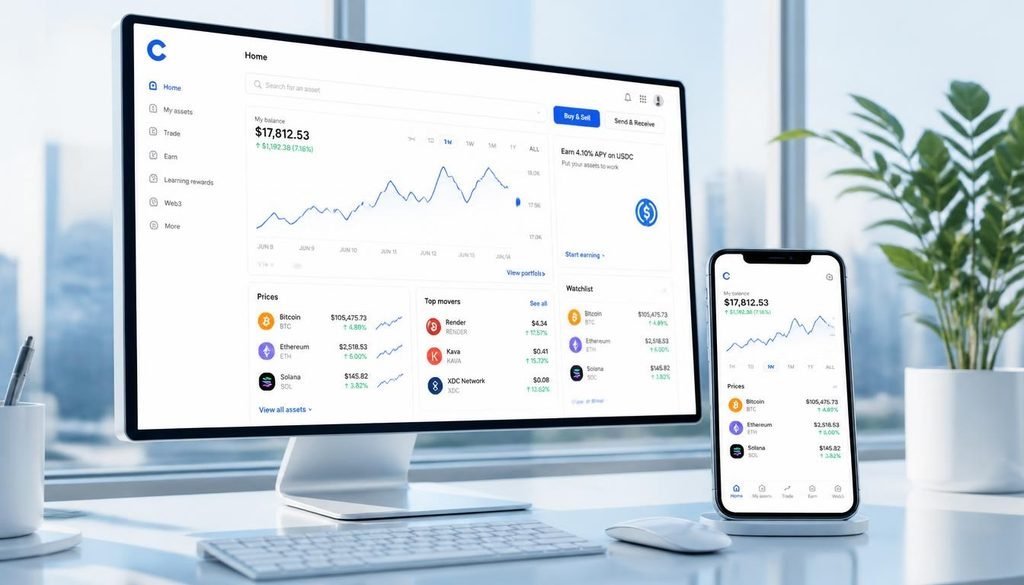
Which Cryptocurrencies Does Coinbase Support?
Coinbase provides access to a broad selection of digital assets.
Some well-known cryptocurrencies available on its platform include:
- Bitcoin (BTC)
- Ethereum (ETH)
- Solana (SOL)
- XRP
- Litecoin (LTC)
- Cardano (ADA)
- Dogecoin (DOGE)
- USD Coin (USDC)
The available selection changes over time, and not every asset is supported in every location.
Coinbase also provides access to assets operating on different blockchain networks.
This is worth remembering because two tokens with similar names may operate on different networks. Choosing the wrong network when transferring cryptocurrency can result in lost funds.
Before buying or transferring any asset, check its supported networks and the exact deposit or withdrawal instructions.
Coinbase Fees: What Does It Cost?
Fees are one of the most important things to consider when comparing cryptocurrency exchanges.
Coinbase does not use one universal fee for every transaction.
The final cost depends on several factors, including the trading interface, transaction size, payment method, asset, market conditions and the user’s location.
Standard Coinbase Trading
The standard Coinbase buying and selling interface is designed for convenience.
However, simplicity can come with additional costs.
Depending on the transaction, the displayed price may include a spread, and Coinbase may charge a separate transaction fee.
Before confirming a purchase, users can review the transaction preview to see the estimated total cost.
This is particularly important when purchasing smaller amounts, where transaction charges can represent a noticeable percentage of the order.
Coinbase Advanced Fees
Coinbase Advanced offers a different fee structure.
It uses maker and taker fees.
A maker order adds liquidity to the order book, while a taker order matches an existing order.
The applicable rates depend on the user’s fee tier and trading activity.
One advantage of Coinbase Advanced is that trades are executed directly through the order book, without the spread included in the standard Coinbase Advanced pricing model.
This can make it more attractive for people who trade regularly and want greater control over execution prices.
Other Possible Costs
Apart from trading fees, users should also consider:
- Card payment processing charges, where applicable.
- Bank transfer fees imposed by payment providers.
- Cryptocurrency network fees.
- Conversion costs.
- Fees associated with certain additional services.
Coinbase displays applicable charges before a transaction is confirmed.
My advice is simple: do not compare exchanges using advertised trading fees alone. Look at the total cost of buying, selling and withdrawing your cryptocurrency.
Coinbase Payment Methods
Coinbase supports different ways of funding accounts and purchasing cryptocurrency.
However, available options depend heavily on the user’s location, supported fiat currency and payment provider.
Common payment methods may include:
Debit Cards
Eligible debit cards can provide a convenient way to purchase supported cryptocurrencies.
The transaction is generally straightforward, although processing fees and purchase limits may apply.
Credit Cards
Credit card availability depends on the payment provider, card issuer and applicable regional restrictions.
Users should check the payment options displayed in their account rather than assume that every card will work.
Bank Transfers
Bank transfers are another possible way to add funds.
Depending on the supported banking infrastructure, transfers may take longer than card purchases.
They can be useful for people who prefer funding an account before making a transaction.
Cryptocurrency Transfers
Existing cryptocurrency holders can transfer supported digital assets into their Coinbase accounts.
This is useful if you already own Bitcoin, Ethereum or another supported cryptocurrency on a different exchange or personal wallet.
Always verify the destination address and blockchain network before sending funds.
Coinbase Advanced: A Platform for More Experienced Users
Not everyone wants to use the simplest possible trading interface.
Some users prefer to analyse price movements, compare market liquidity and decide exactly when an order should be executed.
This is where Coinbase Advanced becomes useful.
It offers several tools, including:
- Advanced price charts.
- Real-time order books.
- Market and limit orders.
- Trading pairs.
- Market information.
- Customisable trading layouts.
- API access for supported trading activities.
For example, a market order generally executes against available liquidity at the current market price.
A limit order allows the user to specify a price at which they are willing to buy or sell.
This gives traders more flexibility, although it also requires a better understanding of how cryptocurrency markets work.
Coinbase Advanced is not necessarily the best starting point for someone who has never purchased cryptocurrency before.
I would suggest learning the basics first and exploring advanced tools later.
Coinbase Wallet: What Is the Difference?
An important part of the Coinbase ecosystem is Coinbase Wallet.
It is worth understanding that Coinbase exchange accounts and Coinbase Wallet are not the same thing.
A regular Coinbase account is a custodial service. The platform manages the cryptocurrency held in the exchange account.
Coinbase Wallet is a self-custody wallet.
This means users have control over their wallet’s recovery phrase and are responsible for protecting access to their assets.
Coinbase Wallet can be used to interact with supported blockchain networks, decentralised applications and digital assets.
It offers a different level of control, but also introduces additional responsibilities.
For example, losing access to your recovery phrase can mean losing access to the wallet.
Never share your recovery phrase with anyone, including someone claiming to represent Coinbase support.
It is also important to understand that transactions made through decentralised applications can involve smart contract risks and other technical issues.
Coinbase Staking and Rewards
Coinbase also provides access to staking services for eligible cryptocurrencies.
Staking allows holders of certain proof-of-stake assets to participate indirectly in blockchain network validation and potentially receive rewards.
The available cryptocurrencies and reward rates depend on the network and the user’s eligibility.
Some important points to understand:
- Staking rewards are not guaranteed.
- Annual percentage yields can change.
- Coinbase may deduct a commission from staking rewards.
- Unstaking may involve a waiting period.
- Some blockchain networks have specific withdrawal conditions.
There is also a possibility of slashing or other network-related risks, depending on the cryptocurrency.
Staking should not be confused with a guaranteed savings account.
The value of the underlying cryptocurrency can fall, and rewards do not protect users from market losses.
Coinbase publishes information about eligible assets and its staking services on its official website.
Coinbase One: Is the Subscription Worth It?
Coinbase offers a subscription service called Coinbase One.
It provides certain benefits to eligible members, depending on the subscription plan and location.
Some benefits may include:
- Eligible zero-trading-fee purchases and sales within specified limits.
- Additional account support.
- Selected rewards and membership benefits.
- Other services depending on the subscription tier.
However, zero trading fees do not necessarily mean every transaction is completely free.
Spread costs, certain service charges and other exclusions may still apply.
Whether Coinbase One is worthwhile depends on how frequently someone uses the platform.
For an occasional buyer, paying for a subscription may not make much sense.
For more active users, it may be worth comparing the membership price with the potential savings and other benefits.
Always read the current subscription terms before signing up.
Is Coinbase Safe?
Security is one of the most important considerations when choosing a cryptocurrency exchange.
Coinbase has developed several security measures designed to protect accounts and digital assets.
These include:
Two-Factor Authentication
Two-factor authentication adds another verification step when accessing an account or performing certain actions.
It can help protect users even if their passwords are compromised.
Passkeys and Biometric Security
Supported devices and applications may offer additional login protection through passkeys and biometric authentication.
Cold Storage
Coinbase uses offline storage arrangements as part of its cryptocurrency custody infrastructure.
Cold storage helps reduce exposure to certain online threats, although it does not eliminate every possible security risk.
Account Monitoring
The company uses security systems to monitor account activity and identify potentially suspicious behaviour.
Withdrawal Protection
Additional verification and security controls may apply when users withdraw funds or make changes to account settings.
These measures are useful, but there is no such thing as a completely risk-free cryptocurrency exchange.
Users should also take responsibility for protecting their accounts.
Use a unique password, enable strong authentication, avoid suspicious links and never disclose verification codes.
It is also important to remember that keeping cryptocurrency on an exchange involves counterparty risk.
An exchange account is not the same as holding digital assets in a self-custody wallet.
Is Coinbase a Legitimate Company?
Coinbase is an established cryptocurrency business founded in 2012.
Its parent company, Coinbase Global, Inc., is publicly traded on the Nasdaq stock exchange under the ticker symbol COIN.
This provides access to public corporate disclosures and financial reporting.
The company operates across different markets and is subject to various regulatory requirements depending on the services and jurisdictions involved.
However, public listing and regulatory oversight should not be interpreted as a guarantee against losses.
Cryptocurrency prices remain volatile, exchange services can experience technical problems, and regulatory conditions can change.
Users should always verify the legal entity providing a particular service and check the applicable terms in their location.
Coinbase Pros and Cons
No cryptocurrency exchange is perfect. Coinbase has several advantages, but there are also limitations worth considering.
Advantages
- Established cryptocurrency company with a long operating history.
- Publicly traded parent company.
- Relatively straightforward interface for beginners.
- Coinbase Advanced for more experienced traders.
- Mobile applications and web access.
- Support for a broad range of cryptocurrencies.
- Additional services, including Coinbase Wallet and staking.
- Multiple account security features.
- Public corporate financial disclosures.
Disadvantages
- Standard buying and selling transactions can involve relatively high costs.
- Fees vary depending on the transaction and location.
- Some services are unavailable in certain markets.
- Identity verification requirements apply.
- Coinbase Advanced may be complicated for newcomers.
- Staking involves additional risks.
- Custodial exchange accounts involve counterparty risk.
Overall, Coinbase offers a broad range of features, but users should compare the costs and conditions with other available exchanges.
Coinbase vs Binance: Which Platform Is Better?
Coinbase and Binance are two major names in the cryptocurrency industry.
Both platforms provide access to digital assets, but their approaches are somewhat different.
| Feature | Coinbase | Binance |
|---|---|---|
| Main focus | Accessible crypto services | Broad trading ecosystem |
| Beginner interface | Relatively simple | More complex |
| Advanced trading | Coinbase Advanced | Binance Spot and other tools |
| Crypto selection | Broad selection | Broad selection |
| Additional services | Wallet, staking, subscription | Earn, wallet and other services |
| Fees | Depend on product and payment method | Depend on product and fee tier |
| Mobile app | Available | Available |
Coinbase may appeal to people who prefer a relatively straightforward buying experience and want access to an established publicly traded crypto company.
Binance may be more interesting to users who want a wider selection of trading tools and a large cryptocurrency ecosystem.
Neither platform is automatically better for everyone.
If you want to understand how the two exchanges approach cryptocurrency purchases and payments, you can also read our guides:
- Binance Payment Methods: How to Buy and Withdraw Crypto
- How to Buy Cryptocurrency on Binance: A Beginner’s Guide
Who Should Consider Coinbase?
Coinbase may be worth researching for several types of users.
People Buying Cryptocurrency for the First Time
The simplified interface can make basic purchases easier to understand.
Long-Term Cryptocurrency Holders
Users who want to buy and hold supported digital assets may find the platform convenient.
People Interested in Advanced Trading
Coinbase Advanced offers tools for those who want more control over their orders and market analysis.
Users Interested in the Wider Crypto Ecosystem
Coinbase Wallet, staking and other services provide additional ways to interact with digital assets.
However, people who trade frequently should pay particular attention to the fee structure.
Those who prefer complete control over their private keys should also understand the difference between an exchange account and self-custody.
Frequently Asked Questions
Is Coinbase a good cryptocurrency exchange?
Coinbase is an established exchange offering cryptocurrency purchases, trading, storage and additional services. Whether it is suitable depends on the user’s experience, location, fees and preferred features.
Is Coinbase suitable for beginners?
Yes. Its standard interface is designed to make basic cryptocurrency purchases relatively straightforward. Beginners should still understand transaction costs and the risks of digital assets.
Does Coinbase charge fees?
Yes. Fees depend on the transaction type, payment method, trading interface, market conditions and location. The final charges are displayed before confirming a transaction.
Does Coinbase have a mobile application?
Yes. Coinbase provides mobile applications for supported Android and iOS devices.
Can I buy Bitcoin on Coinbase?
Yes. Bitcoin is one of the main cryptocurrencies supported by Coinbase. Availability and payment options depend on the user’s location.
Does Coinbase offer staking?
Yes. Eligible customers can access staking for supported cryptocurrencies. Rewards vary, and staking involves network and market risks.
What is Coinbase Wallet?
Coinbase Wallet is a self-custody cryptocurrency wallet that allows users to manage supported digital assets and interact with blockchain applications.
It is separate from the regular custodial Coinbase exchange account.
Is Coinbase publicly traded?
Yes. Coinbase Global, Inc. is listed on Nasdaq under the ticker symbol COIN.
Can I withdraw cryptocurrency from Coinbase?
Yes. Users can withdraw supported cryptocurrencies to eligible external wallets. Network availability, withdrawal fees and account restrictions may apply.
Is Coinbase better than Binance?
It depends on what you need. Coinbase offers a relatively simple buying experience, while Binance provides a broad ecosystem of trading tools. Comparing fees, available services and security requirements is the best way to make a decision.
Final Verdict: Is Coinbase Worth Considering in 2026?
Coinbase has established itself as one of the major companies in the cryptocurrency industry.
Its operating history, publicly traded parent company, relatively accessible interface and range of additional services make it an interesting platform for people researching cryptocurrency exchanges.
One of its strongest points is the combination of simple buying features and more advanced tools. Users do not necessarily need to move to another exchange when they become more familiar with cryptocurrency trading.
At the same time, there are some disadvantages.
Transaction costs can be higher than expected if users do not pay attention to spreads and payment charges. Not every service is available everywhere, and the more advanced features require some experience.
Security is another area that deserves attention. Coinbase offers several protective measures, but users should never assume that cryptocurrency held on a centralised exchange is completely risk-free.
Our conclusion: Coinbase is a well-established cryptocurrency platform worth researching in 2026, particularly for users who value an accessible interface and a range of services under one account. However, it is important to compare fees, check regional availability and understand the risks before depositing funds.
If you are considering opening an account, take some time to explore the available services and read the terms that apply to your location.
Explore Coinbase: Visit Coinbase and check the available services.
Disclaimer: This article is for informational and educational purposes only. It does not constitute financial or investment advice. OnlineInvestWatch may receive compensation if readers register through certain links. Cryptocurrency investments involve significant risks, including the possibility of losing your entire investment. Always conduct independent research before making financial decisions.
Editorial note: This review reflects information available in November 2026. Fees, supported cryptocurrencies, product availability and service conditions may change.