
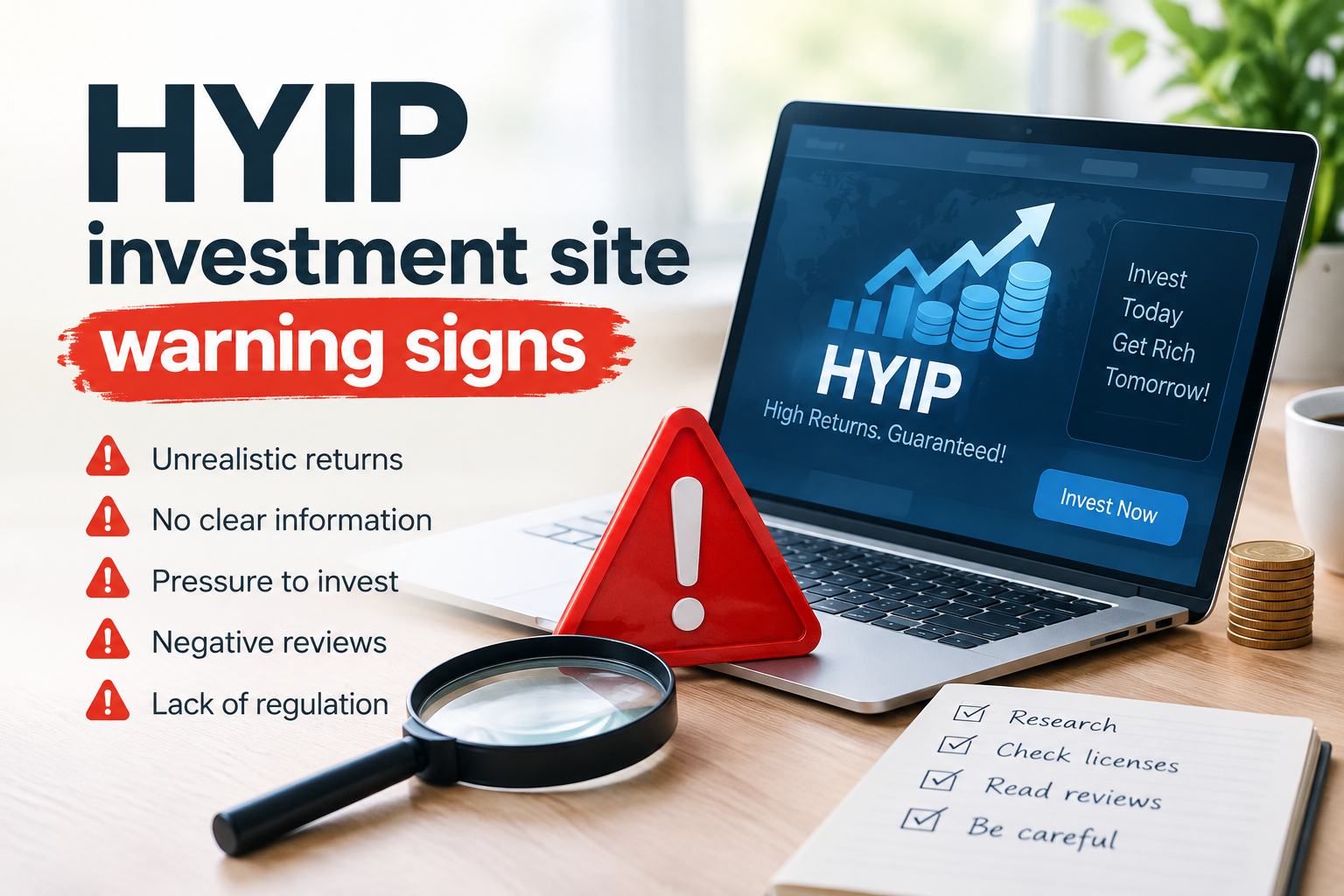
HYIP websites can be very convincing.
You open one and everything seems to be there: investment plans, a nice dashboard, charts going up, payment screenshots, customer reviews and a promise of making money much faster than with a normal investment.
It is easy to get interested.
The difficult part is figuring out what is actually behind the website.
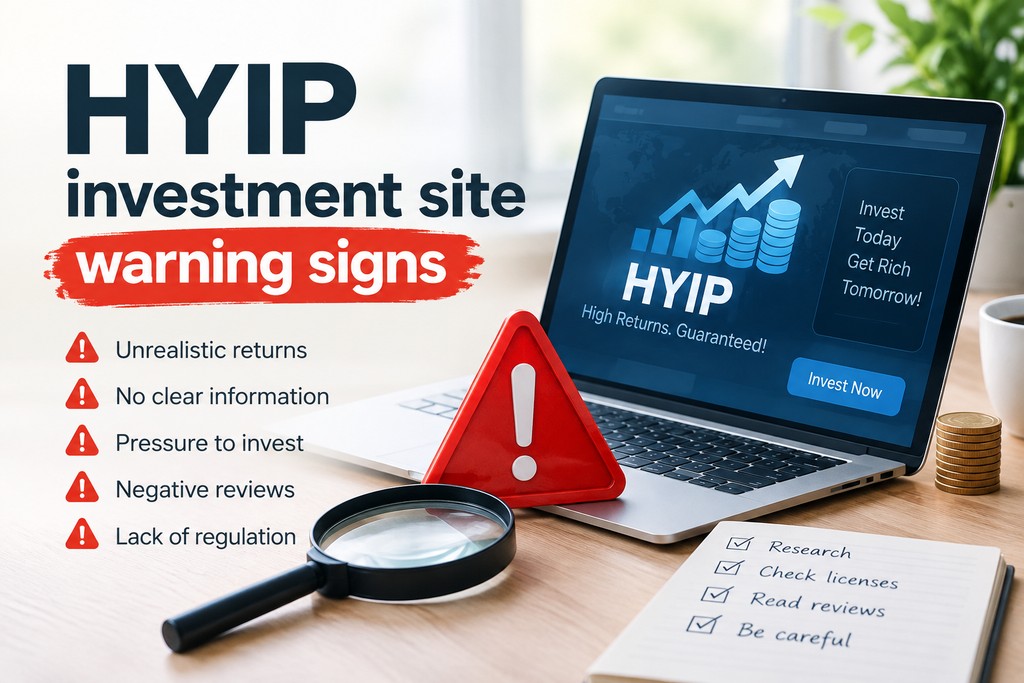
Not every HYIP site is necessarily the same, and a few warning signs do not automatically prove that a platform is a scam. But when several questionable things appear at the same time, I would take a step back before sending any money.
Here are some of the things I would check first.
The promised returns are hard to believe
This is probably the easiest place to start.
If a website is promising extremely high returns every day or every week, ask yourself where that money is supposed to come from.
For example, a plan promising a small return over a short period may sound reasonable at first. But when you calculate the equivalent yearly return, the numbers can become very different.
Some HYIP websites simply show a large percentage without explaining much about the business behind it.
That does not tell you what will happen to your deposit.
A good rule is not to focus only on the number in the investment plan. Try to understand how the company says it earns the money needed to pay investors.
If the answer is basically “our experts generate huge profits”, that does not give you much to work with.
You cannot find much information about the company
Before investing, I would spend a few minutes trying to find out who actually runs the website.
Look for a real company name, registration details, an address and a way to contact the business.
Then go a little further.
Search for the company name outside the website. Check whether the registration information exists and whether it matches what the website says.
Sometimes a site will have an impressive-looking “About Us” page, but very little can be found about the company anywhere else.
That is more useful information than a fancy office photograph on the website.
The website is trying to rush you
Have you ever seen a page saying something like:
“Only 3 hours left!”
or
“This investment plan closes today!”
That kind of message is designed to make you act before you have time to think.
There is nothing wrong with promotions in general. But an investment decision is different from buying a pair of shoes during a weekend sale.
If someone is asking you to send money, taking another day to research the company should not be a problem.
Personally, a platform that constantly pushes urgency would make me more interested in researching it, not less.
The people behind the project are impossible to verify
Many investment websites introduce their “CEO”, “trading team” or “financial experts”.
That sounds reassuring until you try to check who these people actually are.
Search their names.
Look at their professional profiles. Search for older companies or projects they supposedly worked on.
You may find that everything checks out. You may also find that the photographs appear on completely unrelated websites or that there is almost no independent information about the people involved.
The second situation deserves some caution.
A photograph and a job title are easy to put on a website. Verifiable history is much harder to fake convincingly.
The explanation of the business is vague
This is one of the things I would pay particular attention to.
A HYIP might say that it makes money through crypto trading, forex, arbitrage, mining, artificial intelligence or some other high-tech activity.
Those words sound impressive, but they do not explain much by themselves.
Try to find a simple answer to this question:
What is the company actually doing with investors’ money?
You do not need a 50-page trading strategy. But there should at least be a believable explanation of what the business does and where the expected returns are coming from.
If the explanation stays vague no matter how much you read, that is something to keep in mind.
Withdrawals tell you more than the investment plans
When researching an HYIP, I would spend at least as much time looking at withdrawals as I do looking at the advertised profits.
Depositing money is usually the easy part.
The important question is what happens when you want your money back.
Look for information about withdrawal fees, minimum amounts and processing times. More importantly, search for recent experiences from actual users.
Try searches such as:
[site name] withdrawal
[site name] payment
[site name] complaint
[site name] review
Do not rely only on payment screenshots published by the platform itself. Those screenshots may show real transactions, but they do not necessarily tell you what the average investor experiences.
Be careful with perfect reviews
A website covered in glowing five-star reviews can look reassuring.
But take a closer look.
Are the reviews detailed? Do they talk about actual deposits and withdrawals? Are they published by established websites or by accounts that appeared recently?
A review saying “Great platform, paid me fast!” does not tell you very much.
On the other hand, a detailed user report explaining when the person deposited, what payment method was used, how much was withdrawn and how long the withdrawal took is much more useful.
The same applies to negative reviews. One angry comment does not prove much either.
The idea is to look for patterns.
Check the license instead of trusting the logo
Some investment websites display regulatory logos on their pages.
Do not stop there.
If a company says it is licensed or regulated, find the regulator’s official website and search for the company yourself.
Pay attention to the exact company name and the type of authorization it has.
A company being registered somewhere does not automatically mean that every service advertised on its website is regulated.
This is an easy detail to overlook.
Crypto payments need extra care
There is nothing inherently wrong with a website accepting Bitcoin, USDT or another cryptocurrency.
But crypto transfers come with an important difference: once you send the funds, getting them back can be very difficult.
That means I would double-check the payment address and the site’s withdrawal rules before making a deposit.
If the platform only accepts crypto and gives you very little information about who receives the money, I would want to know considerably more before transferring anything.
A good-looking website proves very little
This is probably worth saying because it is easy to forget.
A professional website can be built surprisingly quickly.
A company can have a nice logo, animated charts, a members’ area, live statistics and an impressive-looking investment calculator.
None of that tells you whether the underlying business is sound.
The same applies to an SSL certificate. The padlock in your browser means that the connection is encrypted. It does not mean that the company behind the website has been checked or approved.
The website is only the first layer of the research.
Look at the whole picture
I would not reject an investment website simply because it has one unusual feature.
For example, accepting cryptocurrency is not automatically a warning sign. Neither is having a small company or a relatively new website.
The bigger issue is when several things start adding up.
Maybe the returns are unusually high. The company is difficult to verify. The team is anonymous. The business model is vague. Users complain about withdrawals. And the website is constantly pushing visitors to deposit immediately.
Each point on its own may have an explanation.
Together, they deserve much more attention.
A simple check before depositing
If I were researching an unfamiliar HYIP, I would probably go through these questions before making a decision:
- Who owns and operates the website?
- Can the company information be verified independently?
- How does the business say it generates its returns?
- Are the advertised returns realistic?
- What are people saying about withdrawals?
- Does the claimed license actually exist?
- How old is the website and domain?
- Are the investment terms clear?
- What happens if you want to withdraw early?
- Can you afford to lose the money you are considering investing?
That last question is particularly important.
Even if a platform appears genuine, an investment can still go wrong.
Final thoughts
There is no magic checklist that can tell you with 100% certainty whether an HYIP will succeed or fail.
Websites change. Companies change. Payment policies change. And online reviews can sometimes be difficult to verify as well.
The best you can do is gather as much independent information as possible before putting money into a platform you do not know.
Do not let a large percentage, a countdown timer or a collection of positive testimonials make the decision for you.
Take your time, check the company, look at withdrawal experiences and try to understand where the promised returns are supposed to come from.
Sometimes the most useful warning sign is simply the feeling that there is not enough information to answer basic questions.
When that happens, there is nothing wrong with waiting.