
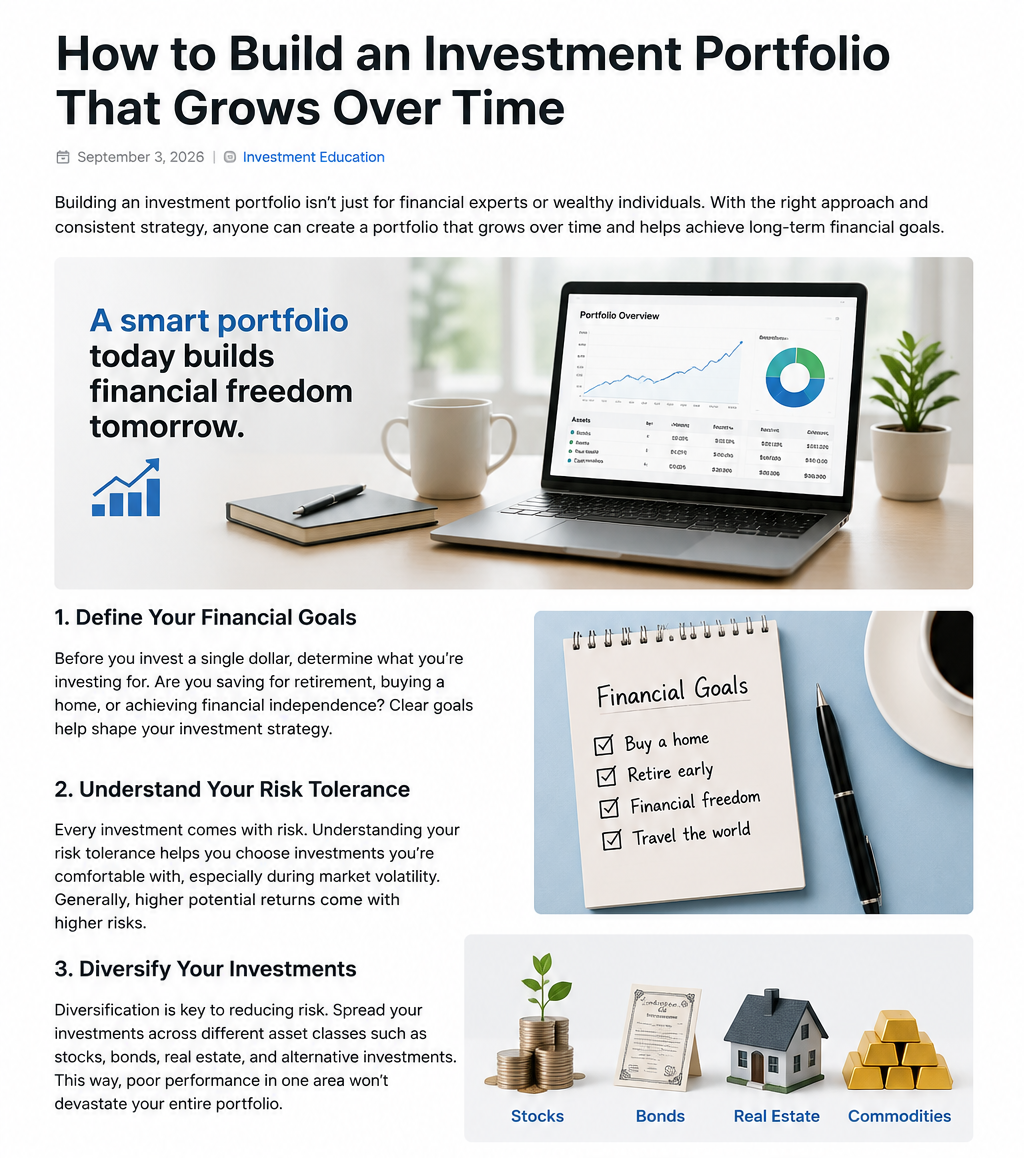
Building an investment portfolio is not only for financial experts or people with large amounts of money. With a clear strategy, realistic expectations, and consistent investing, even beginners can start creating a portfolio designed for long-term growth.
The most important part is not trying to find one investment that will make you rich quickly. Instead, a good approach focuses on diversification, risk management, and patience.
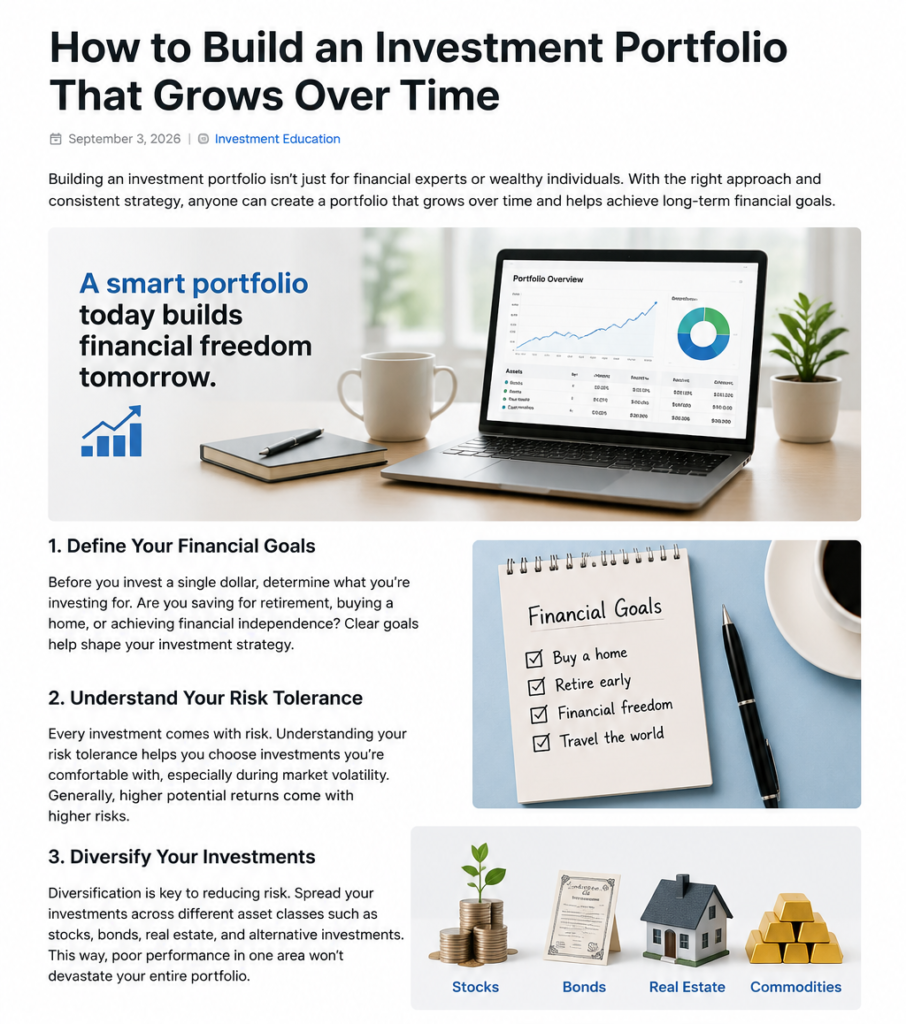
1. Define Your Financial Goals
Before choosing an investment, decide what you want your money to achieve.
Your goals could include:
- Building long-term wealth
- Saving for retirement
- Creating an additional income stream
- Saving for a major purchase
- Protecting your savings from losing purchasing power
Your time horizon matters as well. Money you may need soon generally should not be exposed to the same level of risk as money you can leave invested for many years.
Having a specific goal also makes it easier to determine how much you can realistically invest.
2. Understand Your Risk Tolerance
Every investment involves some degree of risk. Generally, opportunities offering potentially higher returns also involve greater uncertainty.
Before putting money into an investment program, consider how you would react if the value of your investment declined.
Ask yourself:
- Could I afford to lose part or all of this money?
- How long can I leave the money invested?
- Would a temporary loss cause me to make an emotional decision?
- Do I understand how the investment generates returns?
The SEC’s Investor.gov advises investors to research opportunities independently and be particularly cautious of promises of high returns with little or no risk.
3. Diversify Instead of Relying on One Investment
One of the basic principles of portfolio construction is diversification.
Instead of putting your entire investment capital into a single company, platform, asset, or strategy, you can consider spreading your capital across different opportunities.
Depending on your objectives and risk tolerance, diversification may involve different asset classes or investment strategies.
For example, an investor could divide capital between:
- Traditional market investments
- Alternative investment opportunities
- Digital assets
- Fixed-income products
- Other diversified strategies
Diversification does not eliminate risk, but it can reduce the impact of one investment performing poorly.
4. Start With an Amount You Can Afford
You do not necessarily need thousands of dollars to begin learning about investing.
Starting with a smaller amount can allow you to understand how a platform works, how returns are calculated, and what risks are involved without immediately exposing a large portion of your savings.
However, never invest money that you need for essential expenses or emergency savings.
A simple approach is to establish an investment budget and contribute consistently rather than making large decisions based on short-term market excitement.
5. Research an Investment Program Before Depositing Money
This step is particularly important when considering unfamiliar online investment opportunities.
Before investing, research:
- Who operates the platform
- How the company makes money
- What assets or activities generate the advertised returns
- What fees apply
- What withdrawal conditions exist
- What risks are disclosed
- Whether the company provides verifiable information
- Whether independent sources have reviewed the platform
Do not rely solely on advertisements, testimonials, social-media posts, or promises made by anonymous accounts.
Investor.gov specifically recommends conducting independent research before investing and warns that unsolicited online investment promotions can be associated with fraud.
6. Be Careful With Guaranteed Returns
One of the biggest warning signs is a claim that an investment can provide unusually high returns with virtually no risk.
Legitimate investments can produce attractive returns, but there is normally a relationship between potential return and risk.
Be especially cautious when a website uses phrases such as:
- “Guaranteed profits”
- “Zero risk”
- “Guaranteed daily income”
- “No possibility of loss”
- “Get rich quickly”
The SEC warns that guaranteed high returns with little or no risk are a classic investment-fraud warning sign.
7. Review Your Portfolio Regularly
Creating a portfolio is not a one-time event.
Your financial situation, goals, and risk tolerance can change over time. Investment opportunities can also change, which means your portfolio should be reviewed periodically.
A regular review can help you determine:
- Whether your portfolio remains diversified
- Whether your risk level is still appropriate
- Whether individual investments are performing as expected
- Whether fees have changed
- Whether you should reduce exposure to a particular opportunity
The goal is not to constantly buy and sell. Instead, it is to make sure your investments still match your original plan.
8. Avoid Emotional Investment Decisions
Fear and excitement can both lead to poor financial decisions.
Investors may rush into an opportunity because they believe everyone else is making money. Conversely, they may sell everything after seeing a temporary decline.
A long-term strategy can help reduce emotional decision-making.
Before investing, establish your rules in advance: how much you will invest, what level of risk you accept, and under what circumstances you will reconsider an investment.
Where Can You Research Online Investment Opportunities?
If you are researching different online investment opportunities, you can browse our [Investment Programs] section to compare available programs and learn more about the opportunities we cover.
Remember that appearing in a directory or review does not automatically mean an investment is safe or suitable for everyone. Always perform your own due diligence before committing funds.
Final Thoughts
Building an investment portfolio that grows over time is more about consistency and risk management than finding a single perfect investment.
Start with realistic goals, understand the risks, diversify where appropriate, research every opportunity carefully, and avoid investments that promise unrealistic returns.
Most importantly, never let urgency or fear of missing out replace proper research. A thoughtful investment decision made slowly is usually better than a rushed decision made under pressure.