
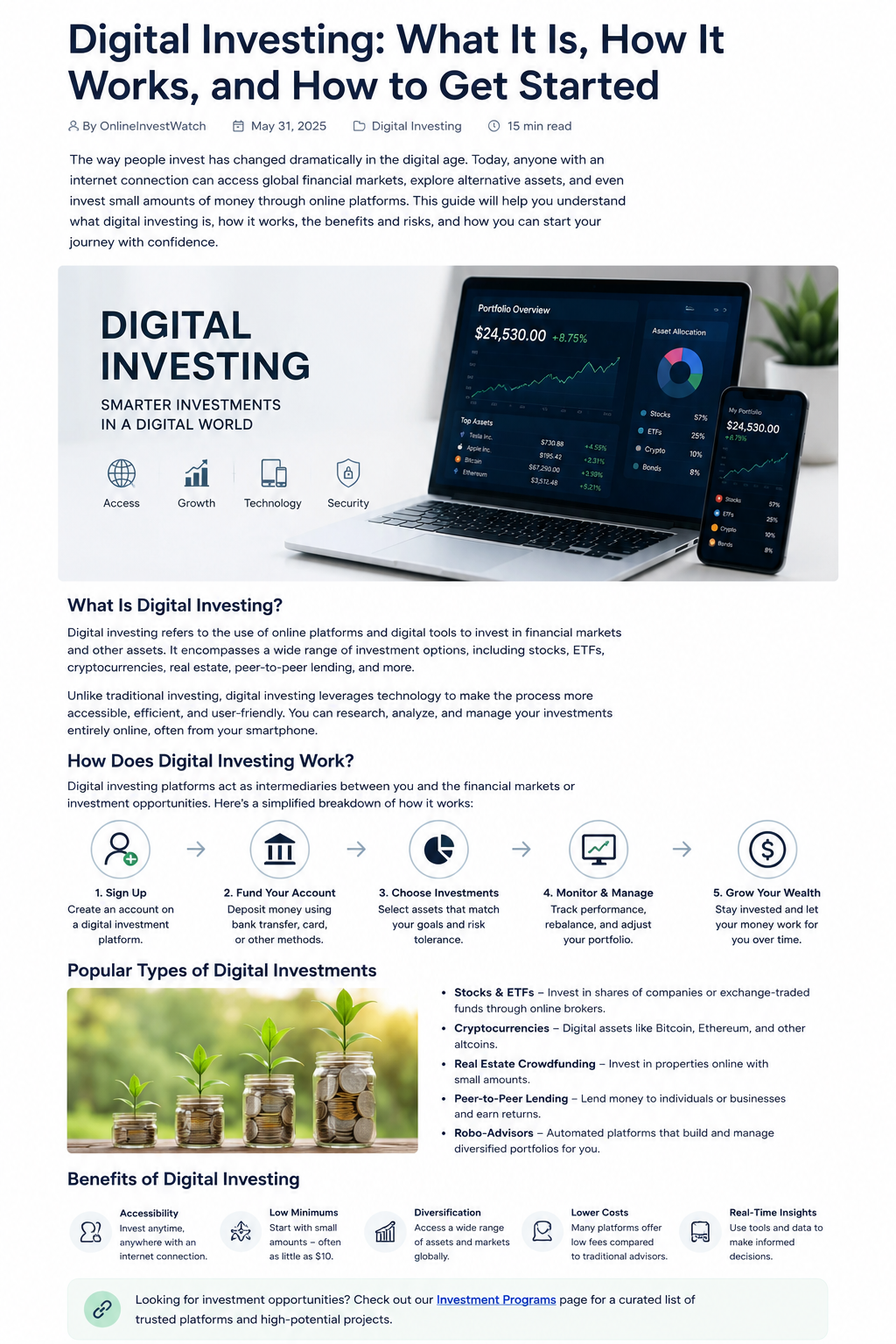
The way people invest has changed dramatically with the growth of financial technology. Today, investors can access stocks, ETFs, cryptocurrencies, real estate opportunities, crowdfunding platforms, and other investments directly from a computer or smartphone.
This approach is commonly referred to as digital investing.
Digital investing can make investing more accessible and convenient, but it also comes with risks. Understanding how digital investment platforms work, what types of opportunities are available, and how to evaluate them is essential before putting your money at risk.
In this guide, we explain what digital investing means, how it works, the most popular types of digital investments, their advantages and risks, and how beginners can get started.
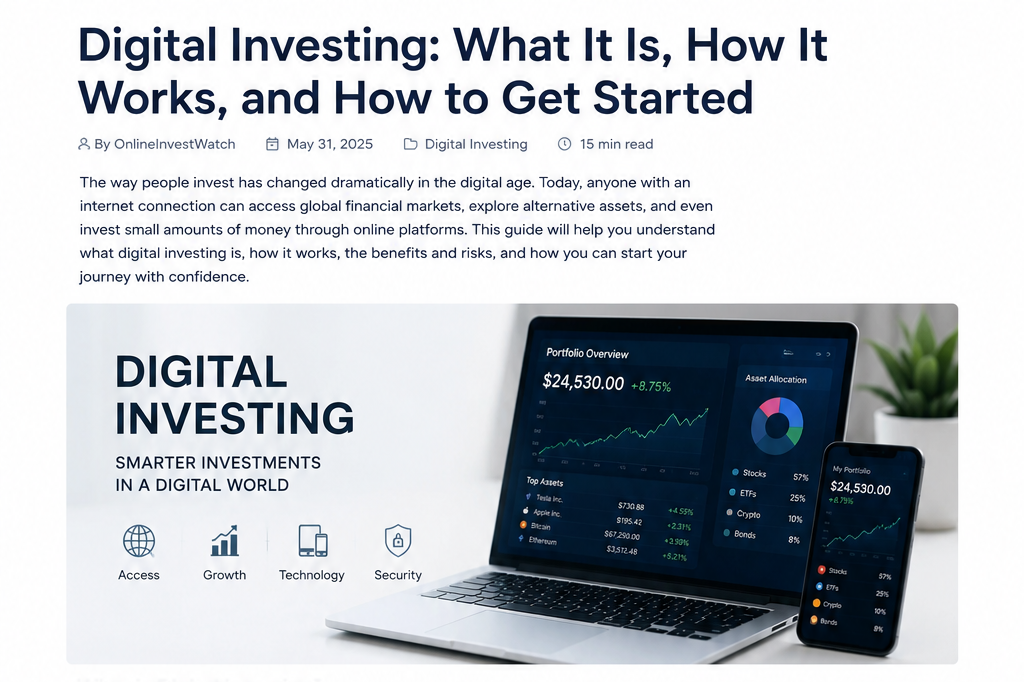
What Is Digital Investing?
Digital investing is the use of online platforms, websites, mobile applications, and other digital technologies to research, purchase, manage, or monitor investments.
Instead of visiting a traditional financial institution or working exclusively with an investment adviser, investors can often manage their portfolios online.
Depending on the platform, digital investing can provide access to:
- Stocks and shares
- Exchange-traded funds (ETFs)
- Bonds
- Cryptocurrencies
- Real estate investments
- Peer-to-peer lending
- Crowdfunding
- Startup investments
- Automated investment portfolios
- Other online investment opportunities
The exact opportunities available depend on the platform, country, regulations, and investor eligibility.
How Does Digital Investing Work?
Although platforms can differ considerably, the basic process is usually straightforward.
1. Choose an Investment Platform
First, an investor selects an online broker, investment application, crowdfunding platform, or another digital investment service.
Before registering, it is important to research the company, understand its fees, check what regulatory protections may apply, and read independent reviews where available.
2. Create an Account
Most platforms require users to create an account and complete an identity verification process.
Depending on the service and jurisdiction, investors may be asked about their financial situation, investment experience, or risk tolerance.
3. Fund the Account
After opening an account, investors can usually add money through a supported payment method, such as a bank transfer or another available funding option.
Always check deposit, withdrawal, conversion, and transaction fees before transferring funds.
4. Choose Investments
The next step is selecting investments that match your objectives and risk tolerance.
For example, one investor may prefer diversified ETFs, while another may be interested in individual stocks, real estate crowdfunding, or digital assets.
5. Monitor Your Portfolio
Digital platforms make it possible to monitor investments through dashboards and mobile applications.
However, checking prices constantly is not necessarily a good investment strategy. Your approach should depend on your objectives, time horizon, and risk tolerance.
Popular Types of Digital Investments
Digital investing is a broad category rather than a single investment product.
Stocks and ETFs
Online brokers allow investors to purchase shares of publicly traded companies and exchange-traded funds.
ETFs can provide exposure to a group of assets rather than a single company, which can make diversification easier.
Cryptocurrencies
Cryptocurrencies such as Bitcoin and Ethereum can be purchased and managed through digital platforms.
Crypto markets can be highly volatile, and investors can potentially lose a substantial portion or all of their investment. Understanding the risks of digital assets is particularly important before investing.
Real Estate Crowdfunding
Some online platforms allow investors to participate in real estate projects without purchasing an entire property themselves.
Depending on the structure, investors may receive income, potential capital appreciation, or another type of return. However, real estate investments can be illiquid and project-specific risks can be significant.
Peer-to-Peer Lending
Peer-to-peer lending platforms connect investors with individuals or businesses seeking financing.
Investors may receive interest payments in return for providing capital, but borrowers can default and returns are not guaranteed.
Robo-Advisors
Robo-advisors use automated technology to create and manage investment portfolios based on information provided by the investor.
They can be useful for people who want a relatively hands-off approach, although fees, investment choices, and services vary between providers.
Crowdfunding and Startup Investments
Some digital platforms allow investors to participate in businesses, startups, or specific projects.
These investments can offer significant growth potential, but early-stage businesses have a high failure rate and investments may be difficult to sell.
Benefits of Digital Investing
Digital investing has become popular for several reasons.
Accessibility
Many investment platforms can be accessed from almost anywhere with an internet connection.
This has made financial markets more accessible to people who previously had limited investment options.
Lower Barriers to Entry
Some platforms allow investors to start with relatively small amounts of money.
However, a low minimum deposit does not mean that an investment itself is low-risk.
Convenience
Investors can research opportunities, place orders, monitor portfolios, and manage accounts online.
Diversification
Digital platforms can provide access to different asset classes and markets, making it easier to build a diversified portfolio.
Real-Time Information
Many platforms provide charts, market data, portfolio statistics, and other information that can help investors monitor their holdings.
What Are the Risks of Digital Investing?
Convenience does not eliminate investment risk.
Before investing online, consider the following.
Market Risk
The value of stocks, cryptocurrencies, funds, and other assets can fall. Past performance does not guarantee future results.
Platform Risk
Not every online investment platform provides the same level of protection, transparency, or regulation.
Always research who operates a platform and where it is legally registered.
Security Risk
Online accounts can be targeted by phishing, hacking, stolen passwords, and other forms of cybercrime.
Use strong passwords, two-factor authentication where available, and never share account credentials.
Liquidity Risk
Some investments cannot be sold quickly.
This can be particularly important with crowdfunding, private companies, and certain alternative investments.
Scam Risk
Promises of unusually high or guaranteed returns should always be treated with caution.
Before sending money to an online investment platform, investigate the company, its ownership, registration, terms and conditions, withdrawal rules, and reputation.
How to Start Digital Investing as a Beginner
If you are new to digital investing, there is no need to begin with a complicated strategy.
A simple approach can be:
1. Learn the basics.
Understand how different asset classes work and what can cause their prices to rise or fall.
2. Define your goals.
Decide whether you are investing for long-term growth, income, a specific financial goal, or another objective.
3. Determine your risk tolerance.
Consider how much loss you could realistically tolerate without abandoning your strategy.
4. Research the platform.
Check fees, regulation, security features, withdrawal conditions, and available investments.
5. Start with an amount you can afford to lose.
Never invest money needed for essential expenses.
6. Diversify where appropriate.
Putting all your money into one company, asset, or platform can create unnecessary concentration risk.
7. Keep learning.
Investment knowledge is an ongoing process. Continue researching before increasing your exposure.
How to Evaluate a Digital Investment Opportunity
Not every opportunity presented online deserves your money.
Before investing, ask:
- Who operates the platform?
- Is the company registered or regulated where it claims to operate?
- How does the investment generate returns?
- What are the fees?
- How and when can you withdraw your money?
- What are the major risks?
- Is there a clear legal agreement?
- Are the company’s contact details verifiable?
- Are returns presented realistically?
- Can you find independent information about the company?
If the answers are unclear, take a step back and conduct more research.
Digital Investing vs. Traditional Investing
The main difference is usually how investors access and manage their investments, rather than the underlying asset itself.
For example, buying shares through an online broker is a form of digital investing, but the shares themselves are traditional financial assets.
Digital technology primarily changes the way investors access information, execute transactions, and manage portfolios.
This can make investing faster and more convenient, but it does not automatically make investments safer or more profitable.
Is Digital Investing Safe?
There is no single answer because digital investing includes many different products and platforms.
Buying a diversified investment through a well-established regulated broker involves very different risks from sending money to an unknown online investment website promising unusually high returns.
The most important principle is to evaluate the investment and the platform separately.
A professional-looking website does not prove that an investment opportunity is legitimate.
Final Thoughts
Digital investing has transformed the way individuals access financial markets and investment opportunities.
From stocks and ETFs to cryptocurrencies, crowdfunding and automated portfolios, investors now have more choices than ever before.
However, more choices also require more responsibility.
The best starting point is not finding the investment promising the highest return. It is understanding how the investment works, researching the platform, evaluating the risks, and investing only an amount you can afford to lose.
If you are researching different online investment opportunities, you can also explore our Investment Programs and Reviews sections for additional information and due-diligence resources.
Remember: investment returns are never guaranteed, and every investment carries some level of risk.