
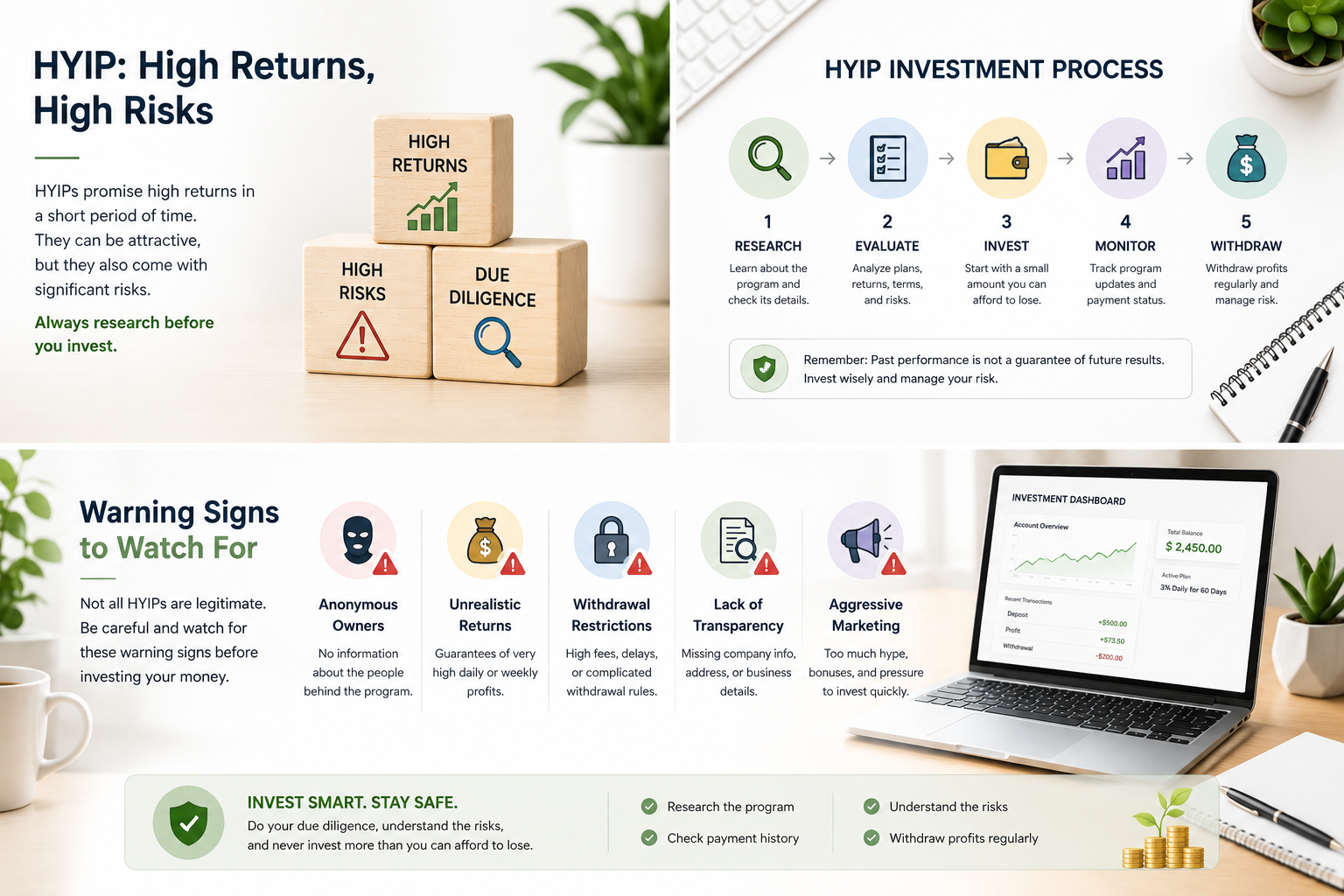
High-Yield Investment Programs (HYIPs) attract attention because they often promise returns that traditional investments cannot match. Daily or weekly profits, short investment periods, and automated payouts can make these programs look highly attractive.
However, high potential returns always come with significant risks. Understanding these risks is essential before depositing any money into a HYIP program.
This article explains the most common HYIP investment risks, how investors can recognize warning signs, and what factors should be considered before making a decision.
What Is a HYIP?
A High-Yield Investment Program is an online investment platform that typically advertises unusually high returns over a relatively short period.
HYIPs may offer different investment plans, such as daily returns for 30, 60, or 90 days. Some programs accept cryptocurrencies, while others may support traditional payment methods.
The structure and legitimacy of HYIPs can vary considerably. Some websites may operate for a relatively long period, while others can disappear shortly after collecting deposits.
Because of this uncertainty, investors should never treat a HYIP as a guaranteed source of income.
Why Are HYIPs Considered High Risk?
The main reason is the combination of unusually high advertised returns and limited transparency.
Traditional financial investments generally provide returns that correspond to the underlying assets and market conditions. A HYIP promising several percent per day creates a very different risk profile.
Even if a program is currently paying withdrawals, this does not necessarily mean it will continue operating in the future.
A HYIP can experience financial problems, change its terms, suspend withdrawals, or completely disappear.
For this reason, investors should consider HYIPs speculative investments rather than conventional savings products.
The Most Common HYIP Risks
1. The Program May Stop Paying
One of the biggest risks is withdrawal failure.
A HYIP may process withdrawals normally for weeks or months and then suddenly begin delaying payments. In some cases, the website may introduce new conditions or temporarily suspend withdrawals.
Eventually, the platform may become inaccessible.
This is why a program’s current payment status should never be considered a guarantee of future performance.
2. Short Operating History
A newly launched HYIP has little historical information available.
A website that has been online for only a few days cannot provide enough evidence of long-term stability.
Operating history is therefore one of the factors investors should examine when comparing different programs.
However, an older website is not automatically safe either. Even established programs can eventually encounter financial difficulties.
3. Unrealistically High Returns
Extremely high returns should always attract additional scrutiny.
For example, a program advertising several percent every day implies an exceptionally high annualized return. Such numbers are fundamentally different from the returns normally associated with traditional investments.
High advertised profits may be used as a marketing strategy to attract new deposits.
Investors should therefore focus not only on the percentage being advertised but also on whether the business model behind those returns is clearly explained.
4. Lack of Company Information
Another important warning sign is limited information about the company or operators.
Before investing, check whether the website provides:
- A legal company name
- Business registration information
- A physical address
- Contact information
- Terms and conditions
- Privacy policy
- Information about the investment model
- Details about the people or company operating the platform
A website containing only an investment calculator and a deposit page provides very little information for evaluating its credibility.
5. Anonymous or Unverifiable Owners
Some HYIPs provide almost no information about who operates the project.
Anonymous ownership does not automatically prove that a program is fraudulent, but it makes independent verification much more difficult.
If the people behind a financial platform cannot be identified or their claims cannot be verified, investors should consider this an additional risk factor.
6. Withdrawal Restrictions
Investors should carefully examine the withdrawal rules before depositing.
Some programs may have:
- Minimum withdrawal amounts
- Processing delays
- Withdrawal fees
- Manual approval
- Specific withdrawal schedules
- Conditions related to active investment plans
These rules can significantly affect how easily funds can actually be withdrawn.
A profitable-looking investment plan is less attractive if accessing the money is difficult or subject to unexpected conditions.
How to Evaluate a HYIP Before Investing
Risk assessment should happen before making a deposit, not after something goes wrong.
A useful starting point is a detailed due diligence process. Our previous guide, HYIP Due Diligence: What to Check Before You Invest, explains the key factors investors should investigate before committing funds.
You should examine the website’s history, ownership information, investment plans, payment methods, withdrawal conditions, and overall transparency.
It is also useful to compare information from several independent sources rather than relying exclusively on the HYIP’s own website.
Never Invest More Than You Can Afford to Lose
One of the most important principles when dealing with high-risk investments is capital management.
Money needed for rent, bills, food, debt payments, or emergency expenses should not be placed into speculative investment programs.
If someone decides to participate in a HYIP, they should understand that the entire deposited amount could potentially be lost.
Diversification can also help reduce concentration risk. Putting all available capital into a single high-risk program creates considerably greater exposure than distributing a small speculative amount across different opportunities.
Be Careful With Reinvestment
Many HYIPs encourage investors to reinvest profits automatically.
At first, reinvestment can make account balances appear to grow very quickly. However, an increasing balance on a website is not the same thing as money that has been successfully withdrawn.
For example, an account may show a substantial theoretical profit while the platform later changes its withdrawal policy or stops processing payments.
Actual withdrawals are therefore much more important than the balance displayed in an investment dashboard.
Watch for Changes in the Program
A HYIP that changes its rules frequently deserves additional attention.
Important changes may include:
- New investment plans
- Higher minimum deposits
- Increased withdrawal fees
- Reduced withdrawal limits
- Longer processing times
- Changes to payment methods
- Unexpected maintenance periods
- Changes to the company’s terms
Not every change is necessarily negative, but sudden changes affecting withdrawals or investor access should be treated carefully.
Why HYIP Reviews and Monitors Can Be Useful
HYIP monitoring websites can provide useful information about program launches, investment plans, payment status, and reported problems.
However, investors should remember that a listing or positive monitor status does not guarantee that a program is legitimate or financially sustainable.
Monitoring information should be considered one part of the research process rather than the final decision.
The strongest approach is to combine several sources of information and perform your own assessment.
Common Mistakes New HYIP Investors Make
New investors often make similar mistakes.
One is focusing exclusively on the advertised return. A higher percentage can look attractive, but it also usually means greater risk.
Another mistake is investing because someone claims to have received a successful withdrawal. One or several successful withdrawals do not prove that a program will continue paying indefinitely.
A third mistake is depositing more after seeing early profits. Early payments can create a false sense of security and encourage investors to increase their exposure.
Finally, some investors ignore withdrawal rules until they actually need their money.
Reading the terms before depositing is always safer than discovering restrictions afterward.
Final Thoughts
HYIPs can be attractive because of their high advertised returns, but these opportunities come with substantial uncertainty.
The most important factors to consider include the program’s operating history, transparency, ownership information, investment model, withdrawal conditions, and payment history.
Most importantly, investors should never assume that current payouts guarantee future withdrawals.
A careful research process and sensible risk management can help investors make more informed decisions and avoid unnecessary exposure.
HYIP investments should always be approached as high-risk opportunities, and anyone considering participation should be prepared for the possibility of losing their entire deposit.