
The way people invest is changing.
You no longer necessarily need to visit a bank or investment office to begin building a portfolio. With a digital investment account, many investing activities can be completed online — from opening an account and transferring funds to researching investments and monitoring portfolio performance.
If you are searching for open digital investment online, you may be looking for a simple answer to a practical question:
How can I open an investment account online and start investing digitally?
The answer depends on your country, the investment products you want to access, and the platform you choose. But the basic process is surprisingly similar across many modern investment services.
This guide explains how digital investing works, what to check before opening an account, and how to avoid some of the most common mistakes.
What Is a Digital Investment Account?
A digital investment account is an online account that allows you to access investment products without relying entirely on traditional branch-based services.
Depending on the provider and jurisdiction, a digital investment account may give you access to products such as:
- Stocks
- ETFs
- Bonds
- Mutual funds
- Money market products
- Real estate investments
- Cryptocurrency
- Other investment products
Some platforms allow investors to complete account opening, identity verification, deposits, investment selection, and portfolio management entirely online.
This development has made investing more accessible to people who previously found traditional investment services complicated or inconvenient.
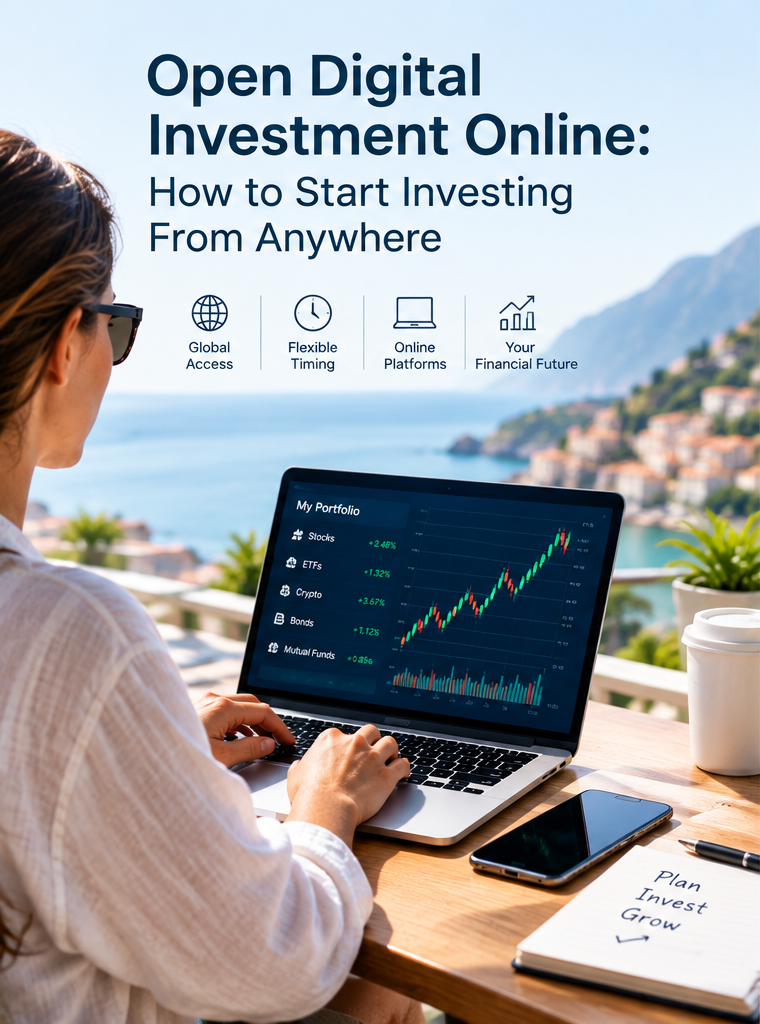
What Does “Open Digital Investment Online” Actually Mean?
The phrase open digital investment online can describe several related activities.
You may want to:
- Open an online investment account
- Open a digital brokerage account
- Start investing from your phone
- Create an online portfolio
- Access digital investment products
- Find an investment platform
- Start investing without visiting a physical branch
These are slightly different things, but they share the same basic idea:
Using digital technology to access and manage investments online.
Modern digital investment services can combine account opening, portfolio management, research, transactions, and reporting in a single online environment.
How to Open a Digital Investment Account Online
Although the exact process varies between providers, opening an online investment account commonly involves several steps.
1. Choose the Type of Investment Account
First decide what you actually need.
You may be looking for a standard investment account, retirement account, brokerage account, or another specialized product.
The right choice depends on your country, tax situation, investment goals, and the products you intend to buy.
Do not choose an account simply because the platform advertises it as “the easiest.”
Look at what the account allows you to do.
2. Research the Investment Platform
Before entering personal information or sending money, research the provider.
Check:
- Who operates the platform
- Where the company is based
- Whether it is regulated where required
- What investments are available
- How client assets are handled
- What fees apply
- How withdrawals work
- What security measures are available
- What customer support is provided
A modern interface is useful.
It is not, however, proof that an investment platform is trustworthy.
3. Complete Online Verification
Many legitimate financial services use digital identity verification and know-your-customer procedures.
You may be asked to provide personal information and documents necessary to verify your identity.
The exact requirements vary by country and provider.
This step can often be completed online rather than at a physical branch.
4. Fund the Account
After the account is approved, you normally need to transfer money into it before purchasing investments.
Available funding methods may include:
- Bank transfer
- Debit card
- Electronic payment methods
- Transfers from another investment account
The available options depend on the platform and your location.
Before depositing, check whether there are funding fees, minimum deposits, currency conversion charges, or withdrawal restrictions.
5. Choose Your Investments
Once your account is funded, you can research the investments available through the platform.
This is where opening an account and actually investing become two different decisions.
Opening an account is an administrative process.
Choosing an investment is a financial decision.
Do not assume that because a product is available on a platform, it is automatically appropriate for you.
Digital Investing Does Not Mean Automatic Investing
One of the biggest misunderstandings about digital investment platforms is that technology somehow removes the need for financial decisions.
It doesn’t.
A digital platform can make buying an investment easier.
It cannot determine with certainty whether that investment will increase in value.
You still need to consider:
- Investment objective
- Time horizon
- Risk tolerance
- Diversification
- Fees
- Liquidity
- Potential losses
Technology changes how you invest.
It does not eliminate investment risk.
Why People Choose Online Investment Platforms
There are several reasons digital investing has become popular.
Convenience
Investors can manage accounts from a computer or smartphone.
Accessibility
Many platforms allow investors to begin with relatively small amounts, although minimums vary.
Speed
Account applications and transactions can often be completed much faster than through traditional paper-based processes.
Information
Digital platforms can provide portfolio data, market information, research tools, and transaction histories in one place.
Automation
Some services allow recurring contributions, automatic portfolio rebalancing, or other automated features.
For example, some digital investment services provide personalized portfolio recommendations based on goals, risk tolerance, and investment horizon.
What Should You Look For in a Digital Investment Platform?
Not every online investment platform is equally suitable.
Instead of looking for the platform with the most impressive homepage, compare the details.
Regulation
Determine whether the provider is regulated or registered where applicable.
The exact regulatory framework depends on the country and type of investment service.
Investment Selection
Check whether the platform offers the investments you actually want.
There is little value in opening an account that does not provide access to your preferred asset classes.
Fees
Compare the total cost of using the platform.
Potential costs may include:
- Trading commissions
- Fund expenses
- Account fees
- Currency conversion fees
- Withdrawal fees
- Transfer fees
- Advisory fees
A platform advertising “zero commission” may still have other costs.
Security
Look for security features such as:
- Two-factor authentication
- Encryption
- Login notifications
- Device controls
- Withdrawal protections
Security should be considered before depositing money rather than after something goes wrong.
Customer Support
Digital does not have to mean unsupported.
Check how customers can contact the provider and whether support is available when you need it.
Digital Investment vs. Traditional Investing
Digital investing does not necessarily mean investing in completely different assets.
You can use a digital platform to access many of the same markets that were historically accessed through traditional financial institutions.
The main difference is the delivery method.
Traditional model:
Investor → Branch or adviser → Account → Investment
Digital model:
Investor → Online platform → Digital account → Investment
This can make investing faster and more convenient.
But convenience can also encourage impulsive decisions.
When buying an investment takes only a few clicks, it becomes even more important to have a plan.
Should Beginners Open a Digital Investment Account?
For many people, an online investment account can be a practical way to access financial markets.
But beginners should avoid confusing simplicity with safety.
An easy-to-use application can make a complex investment appear simple.
Before buying anything, make sure you understand:
What am I buying?
How can I make money?
How can I lose money?
What fees will I pay?
How long do I intend to hold it?
Can I access my money when I need it?
If you cannot answer these questions, spend more time researching before investing.
How Much Money Do You Need to Start Digital Investing?
There is no universal minimum amount.
Some platforms have account minimums. Others allow relatively small initial deposits.
The more important question is whether the amount you invest is appropriate for your personal financial situation.
You should not invest money needed for essential expenses simply because an online platform makes investing easy.
A sustainable investment habit can be more useful than trying to make a large deposit immediately.
Start Small and Learn the Platform
If you are new to digital investing, there is nothing wrong with starting cautiously.
Before committing significant capital, learn how the platform works.
Understand:
- How to buy
- How to sell
- Where portfolio values are displayed
- How fees are reported
- How withdrawals work
- How investment statements are generated
- How security settings work
This reduces the chance of making an avoidable operational mistake.
Digital Investment Opportunities Beyond Stocks
When people hear “online investing,” they often think exclusively about stocks.
The digital investment ecosystem is much broader.
Online platforms can provide access to:
- ETFs
- Bonds
- Funds
- Real estate opportunities
- Peer-to-peer lending
- Cryptocurrency
- Alternative investment programs
- Other digital financial products
Each category has a different risk profile.
For investors exploring alternative opportunities, our Investment Programs section provides additional information about different types of online investment programs and opportunities.
The important rule is simple:
Understand the product before considering the return.
The Difference Between a Digital Investment Platform and an Investment Program
These terms should not be confused.
A digital investment platform is generally the technology or financial service through which an investor accesses investments.
An investment program may refer to a specific opportunity or strategy offering a potential return.
A platform can provide access to multiple investments.
An investment program may represent a single opportunity with its own terms and risks.
This distinction is particularly important when researching online opportunities.
Red Flags When Opening an Online Investment Account
Be cautious if a website:
- Guarantees unusually high returns
- Claims there is no investment risk
- Pressures you to deposit immediately
- Provides little information about the operator
- Makes withdrawal conditions unclear
- Uses fake-looking testimonials
- Promises extraordinary profits from a small deposit
- Requests money to be sent directly to an individual
- Makes it difficult to identify the company behind the service
A professional website is not enough.
Neither is a mobile application.
The underlying company and financial service should be researched independently.
Don’t Choose a Platform Based Only on Its App
A beautiful application can create a sense of confidence.
But the most important features are often invisible.
Before choosing a platform, investigate what happens behind the interface.
Who holds your assets?
What legal entity operates the service?
What regulations apply?
What happens if the platform experiences technical problems?
What are the withdrawal procedures?
What happens if you decide to close your account?
These questions are more important than whether the application has a modern design.
A Simple Digital Investment Setup
A beginner can think about the process in five stages:
Stage 1 — Goal
Define why you are investing.
Stage 2 — Account
Choose an appropriate online investment account.
Stage 3 — Platform
Research regulation, fees, security, and available investments.
Stage 4 — Portfolio
Choose investments that fit your objectives and risk tolerance.
Stage 5 — Review
Monitor your strategy periodically rather than reacting to every market movement.
This framework is simple enough for a beginner while avoiding the temptation to chase the latest investment trend.
How to Make Digital Investing Safer
No investment is completely risk-free, but several habits can improve your decision-making.
Use Strong Account Security
Enable two-factor authentication whenever available.
Keep Your Login Information Private
Never share passwords, authentication codes, or account recovery information.
Verify Websites Carefully
Financial scams can imitate legitimate services.
Check the exact domain before entering personal or financial information.
Understand Withdrawal Procedures
Knowing how you can access your money is just as important as knowing how to deposit it.
Keep Records
Save statements, transaction records, and important account information.
Diversify
Avoid putting your entire investment portfolio into one asset, company, sector, or speculative opportunity.
The Biggest Advantage of Digital Investing Is Also Its Biggest Risk
Digital investing gives investors control and convenience.
You can research an investment at midnight, open an account from home, and place an order within minutes.
That is powerful.
But convenience can also encourage impulsive investing.
The easier it becomes to trade, the easier it becomes to trade without a plan.
The best use of digital investment technology is therefore not to make more transactions.
It is to make better-informed decisions.
Open Digital Investment Online: Final Checklist
Before opening an online investment account, ask:
☐ What is my investment goal?
☐ How long do I plan to invest?
☐ How much risk can I accept?
☐ Is the provider appropriately regulated?
☐ What investments are available?
☐ What are the total fees?
☐ How are my assets held?
☐ How do deposits and withdrawals work?
☐ What security features are available?
☐ Do I understand the investments I plan to buy?
If you can answer these questions, you are in a much better position to evaluate an online investment platform.
Final Thoughts
The phrase open digital investment online reflects a much larger change in the way people access financial markets.
Investing is becoming increasingly digital, with online platforms making account opening, research, transactions, and portfolio management more accessible.
But the technology should remain the tool — not the investment strategy.
A good digital investment process starts with a financial goal, continues with careful platform research, and ends with investments that match your risk tolerance and time horizon.
Don’t open an account simply because the process is easy.
Open one because you understand why you are investing, what you are investing in, and what risks you are accepting.
Digital investing can make access to financial markets easier.
Good research is what can make the decisions behind that access better.